Blog / money-basics
How Much Life Insurance Do I Need? A Simple Way to Figure It Out
How much life insurance do I need? Use a simple step-by-step method, the DIME approach, and a worked example to find a coverage amount that fits your family.

“How much life insurance do I need?” is one of the first questions people ask me, and it’s a good one. Here’s the simple answer: enough to pay off what your family would owe, replace the income they rely on for as many years as they’d need it, and cover the big goals you’d want to happen even if you weren’t here, minus the savings and coverage you already have. That’s it. No magic number, just a little math about your real life.
I’m Sal, a licensed life insurance Financial Professional with Global Financial Impact (license LA-1933647), and a dad. When I ran these numbers for my own family, it changed how I thought about protection. It stopped being about a policy and started being about the people I love. Let’s walk through it together.
The quick version
- Start with what your family would need, not what a policy costs.
- Add up debts, income replacement, and future goals.
- Subtract what you already have, like savings and existing coverage.
- Rules of thumb are a starting point, not the final answer.
- Revisit the number when life changes: a new baby, a new house, a new job.
Why the amount matters
Too little coverage can leave your family selling the house or taking on debt during the hardest time of their lives. Too much coverage can mean paying for more than you need when that money could go toward savings or paying down debt. The goal is a number that fits your family’s real situation.
Why this matters to me
My brother passed away unexpectedly at a young age. I had to watch my mom struggle to pay for his funeral, his gravestone and everything else that came with it. She had to start a GoFundMe at the worst time of her life. And I had to just sit there and watch, as her last remaining son.
It broke me.
So I want to make sure others are protected, so they don’t have to be broken. That’s my mission, and by the grace of God, I get to live it out one family at a time.
If you don’t have coverage yet, or you’re not sure you have enough, please don’t feel bad. Most families I talk with are in the same place. Just take the next small step: work through the steps below, or book a free 15-minute chat and we’ll figure out your number together.
Common rules of thumb (and their limits)
You’ve probably heard shortcuts like these:
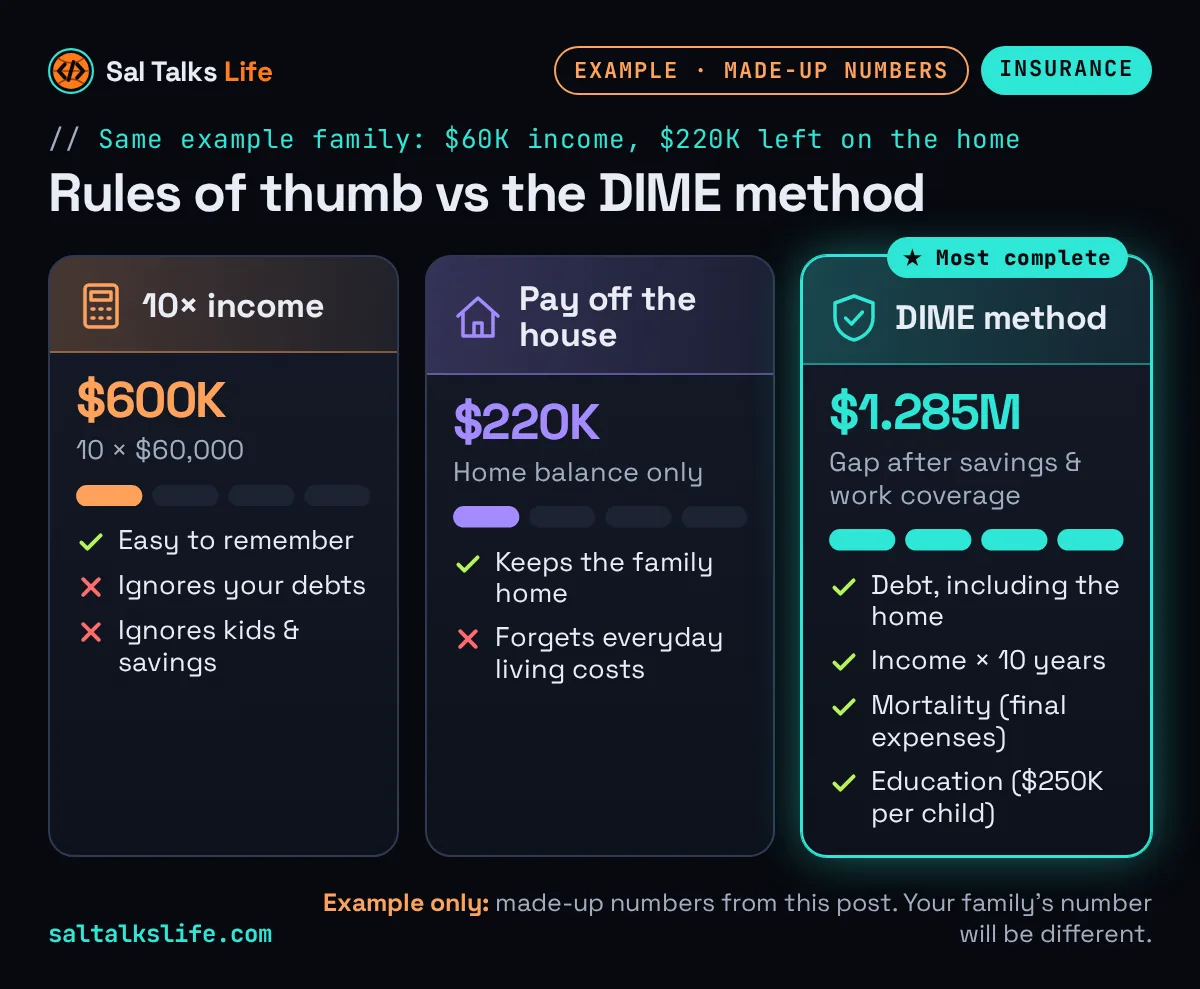
- “10 times your income.” Easy to remember, but it ignores your debts, how many kids you have, and what you’ve already saved.
- “Enough to pay off the house.” Helpful, but it forgets about everyday living costs for the years after.
Rules of thumb are fine for a first guess. But your family isn’t average, so let’s do it the better way.
The DIME method: a simple way to calculate coverage
DIME stands for Debt, Income, Mortality and Education. It’s the simple framework I use with families to get a realistic starting number.
D: Debt
Add up everything you owe: what’s left on your home, car loans, credit cards and student debt. If you rent, some families also add a few years of rent so everyone can stay in place.
I: Income
A common guideline is your yearly income times 10 years. That gives your family a long runway to adjust. You can go higher or lower depending on how young your kids are and how long your family would really need your paycheck.
M: Mortality
This is the cost of dying: the funeral, burial or cremation, a headstone, and other final expenses. This one is personal for me, because it’s exactly the bill my mom was left trying to cover.
E: Education
A guideline many agents use is about $250,000 per child. Adjust it to your family’s real plans, whether that’s college, trade school or something else.
Then subtract what you already have that could help: savings, investments your family could use, and any existing life insurance (like coverage through work).
A worked example with made-up numbers
These numbers are only for illustration. Your situation will be different.
Meet a family with two young kids. One parent earns most of the income.
| Category | Example amount |
|---|---|
| Debt (home $220,000 + car, cards and student debt $40,000) | $260,000 |
| Income ($60,000 a year x 10 years) | $600,000 |
| Mortality (funeral and final expenses) | $15,000 |
| Education (about $250,000 x 2 kids) | $500,000 |
| Total need | $1,375,000 |
| Minus savings | -$30,000 |
| Minus coverage through work | -$60,000 |
| Estimated coverage gap | $1,285,000 |
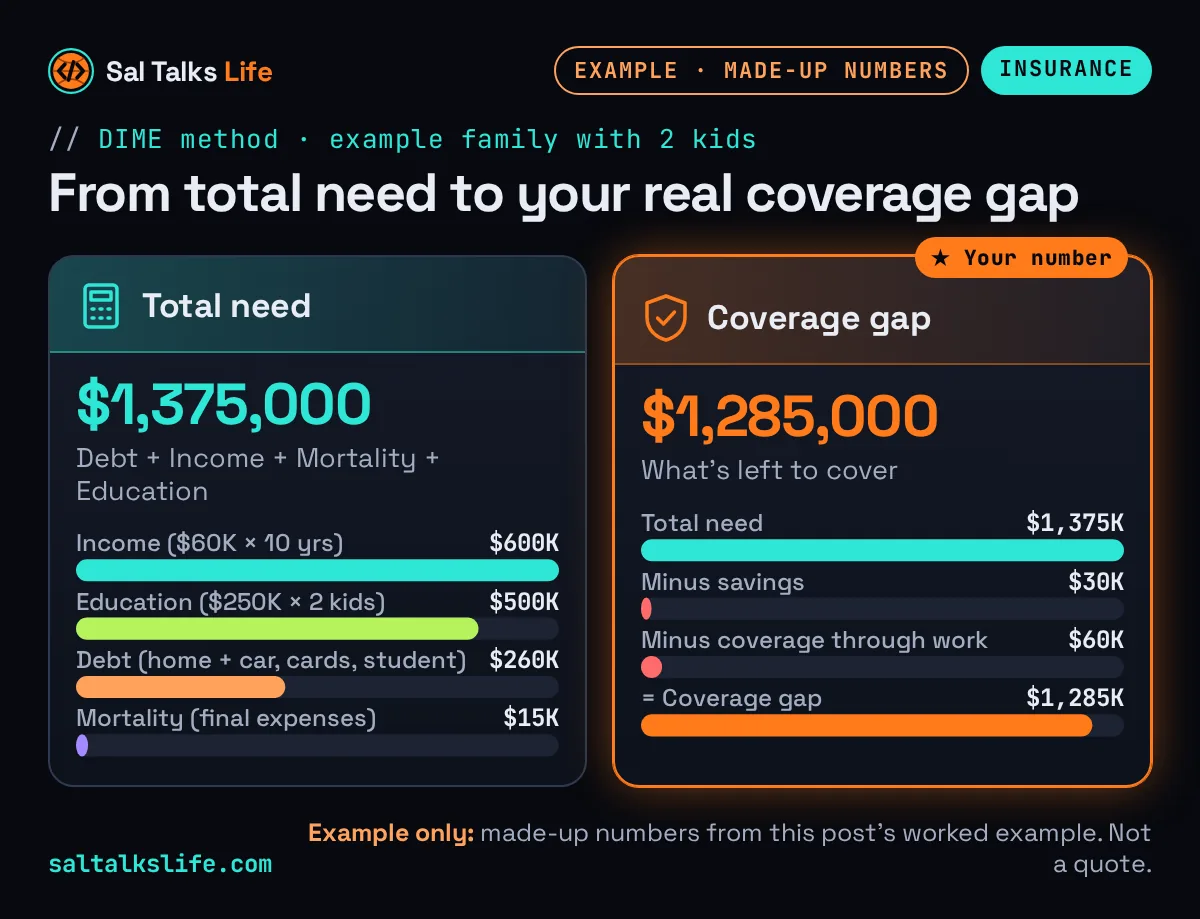
That might look like a big number. But remember, it’s paying off the house, replacing a decade of income, covering final expenses and helping two kids with school. And for a lot of healthy young parents, term life insurance can make a number like this more affordable than they expect. Prices depend on age, health, coverage amount and term length, so the only way to know your real cost is to get a quote.
Notice how this compares with the rules of thumb above. “10 times your income” would say $600,000, and “pay off the house” would say $220,000. DIME is bigger because it counts everything your family would actually face.
If you like to browse on your own first, online companies such as Ladder let you see term life quotes on their websites, and you can also get an instant online quote through my Ethos agent page. And if you’d rather have someone walk through it with you, that’s exactly what my free chat is for.
Don’t forget the stay-at-home parent
This one matters to me. If a parent stays home, their work has real value: childcare, cooking, driving, managing the house. If something happened to them, the family might need to pay for some of that. Many families choose coverage for both parents for this reason.
Coverage through work: helpful, but often not enough
Group life insurance through your job is a great perk. But keep in mind:
- It’s often a set amount or a multiple of your salary, which may not cover your full need.
- It usually ends or changes if you leave the job.
Count it in your math, but many families pair it with an individual policy they own themselves.
How long should the coverage last?
The amount and the length go together. A simple way to think about it:
- Until your kids are grown and on their own.
- Until your mortgage is paid off.
- Until you’ve saved enough that your family wouldn’t need the income.
If those milestones are 20 years away, a 20-year term policy may line up nicely. If you have a lifelong need, like leaving money for a child with special needs, permanent coverage may be worth a look. I explain the difference in Term vs Whole Life Insurance.
Riders and living benefits to ask about
The coverage amount isn’t the only thing to think about. Many policies offer riders, extra features you can add. One I always ask about is living benefits, which can let you access part of your death benefit early for a qualifying chronic, critical or terminal illness. I explain how they work in Term vs Whole Life Insurance.
When to recalculate
Look at your number again when:
- You get married or divorced
- You have or adopt a child
- You buy a home or refinance
- Your income changes a lot
- You pay off big debts
- Your kids become independent
A quick check-in every few years keeps your coverage matched to your life.
FAQ
How much life insurance do I need if I’m single with no kids?
Often less than a parent, since no one depends on your income. Many single people still want enough to cover debts, final expenses, and to help anyone they support, like an aging parent. Buying coverage while you’re young and healthy can also lock in a lower price.
Is 10 times my income enough life insurance?
It might be, but it’s only a rule of thumb. It doesn’t account for your debts, number of kids, savings, or how long your family would need support. A quick DIME calculation gives you a more personal number.
Should both spouses have life insurance?
Many families choose coverage for both. Even if one spouse earns less or stays home, replacing childcare and household work can be expensive. Talk through what your family would actually need without each person.
Does life insurance through work count?
Yes, include it in your math. Just remember that group coverage is often limited and may end if you leave your job, so it’s smart to have coverage you own as well.
Can I change my coverage amount later?
Sometimes. You can usually buy an additional policy later, though price and approval depend on your age and health at that time. Some policies also let you convert or adjust coverage. Ask about these options before you buy.
Let’s figure out your number together
Running these numbers can feel heavy, because it means imagining your family without you. I get it. But I’ve seen how much peace it brings when it’s done. My prayer is that every family I talk with walks away feeling more protected and less worried.
If you’d like help, book a free 15-minute chat. We’ll look at your family, your budget and your goals, and I’ll walk you through your options in plain English, with no pressure. You can also read more on my Financial Services page.
Want more simple money and family tips? Join the free Sal Talks Life newsletter, browse the Money Basics posts, or watch along on YouTube and TikTok.
Some links in this post are affiliate links, which means I may earn a small commission at no extra cost to you. I only share resources I think can help.
Educational content only, not financial advice.
Want the video version? Find more on Sal Talks Life.
Comments & reactions
Comments are coming soon. Until then, ask your question under the matching video on YouTube (opens in a new tab) or TikTok (opens in a new tab), or send me a message.