LLC vs Sole Proprietorship: Which Is Right for Your Side Hustle?
LLC vs sole proprietorship explained simply: liability, taxes, costs, pros and cons, plus an easy way to decide which fits your side hustle or small business.
If you’ve started a side hustle, you’ve probably typed LLC vs sole proprietorship into Google at least once. Here’s the short answer. A sole proprietorship is the simplest way to run a business by yourself. If you start selling, freelancing or making content on your own and never form anything, congratulations, you’re probably already one.
An LLC (limited liability company) is a separate legal business you form with your state. It can help keep your personal stuff separate from business debts and lawsuits. The trade-off is filing fees and some ongoing paperwork. A lot of people start as a sole proprietor and form an LLC once the business grows or the risks get bigger.
I’m Sal. I make UGC for brands, build websites and software, and sell a few beginner ebooks, all on the side of everything else. So I’ve had to think these same questions through for myself. Here’s how I’d explain it to a friend.
The quick version
- Sole proprietorship: easy and cheap to start, but you and the business are legally the same.
- LLC: a separate legal entity that can offer liability protection, with state fees and paperwork.
- Taxes are often similar at first. A single-member LLC is taxed like a sole proprietorship by default.
- The biggest difference is liability, and how seriously you treat the separation between you and the business.
- You can switch later. Starting as a sole proprietor isn’t a forever decision.
What is a sole proprietorship?
A sole proprietorship is a business owned and run by one person, with no legal line between the owner and the business. The IRS describes it as someone who owns an unincorporated business by themselves.
In real life, that means:
- No state formation filing is needed to exist, though you may still need local licenses or permits.
- Business income goes on your personal tax return, usually on Schedule C.
- You’re personally responsible for the business’s debts and legal problems.
- Using a business name different from your own usually means registering a “doing business as” (DBA) name in your area.
What is an LLC?
An LLC is a business structure created under state law. It’s legally separate from you, and that’s where the “limited liability” part comes from.
- You form it with your state, usually by filing articles of organization and paying a fee.
- There may be ongoing requirements, like annual or biennial reports and fees. These vary by state. Some states, including New York, also have extra steps, like publishing a notice after you form.
- Liability protection. In general, business debts and lawsuits are the LLC’s, not yours personally, as long as you keep the business truly separate.
- Flexible taxes. By default, the IRS treats a single-member LLC as a “disregarded entity,” meaning its income is reported on your personal return much like a sole proprietorship. An LLC can also choose to be taxed as a corporation. The IRS explains this on its single-member LLC page.
LLC vs sole proprietorship: side by side
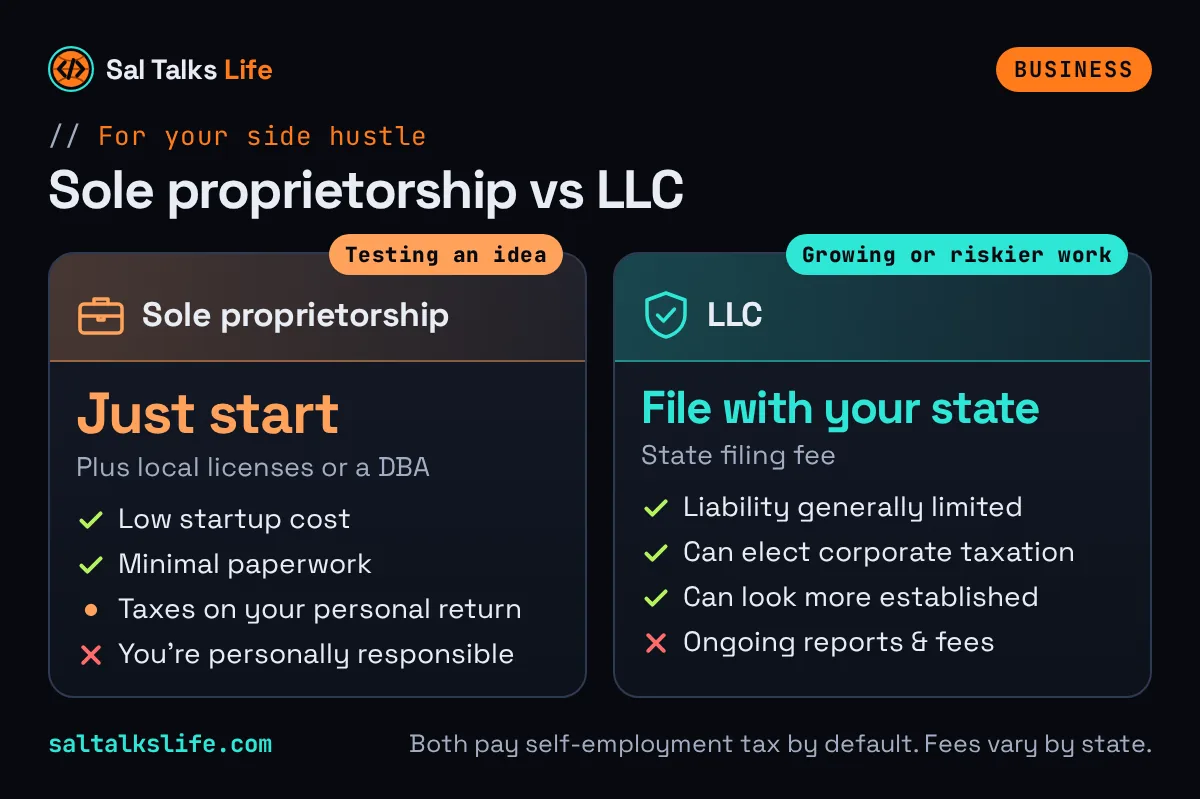
| Sole proprietorship | LLC | |
|---|---|---|
| How to start | Just start (plus local licenses or a DBA if needed) | File with your state |
| Startup cost | Low | State filing fee, varies by state |
| Ongoing paperwork | Minimal | Reports and fees, varies by state |
| Personal liability | You’re personally responsible | Generally limited, if you keep things separate |
| Default federal taxes | Personal return (Schedule C) | Same as a sole prop for single-member LLCs |
| Self-employment tax | Yes, on net earnings | Yes, by default |
| Tax options | Limited | Can elect corporate taxation |
| Credibility with clients | Fine for many small gigs | Can look more established to some clients |
What liability protection really means
This is really the heart of the whole decision. Picture a client claiming your work cost them money, or a customer getting hurt by something you sold. As a sole proprietor, your personal savings, your car and other assets could be on the line. With an LLC, the claim is generally against the business instead.
A few honest notes, though:
- An LLC doesn’t protect you from everything. If you personally cause harm or sign a personal guarantee on a loan, you can still be on the hook.
- Mixing money can weaken protection. Keep a separate business bank account and don’t pay personal bills from it.
- Insurance still matters. Many business owners use business insurance alongside an LLC, not instead of it.
How taxes work for each
Here’s the part that surprises people: for a lot of beginners, taxes look almost the same either way.
- Both report income on your personal return by default (for a single-member LLC).
- Both usually pay self-employment tax on net earnings, which covers Social Security and Medicare.
- Both can deduct ordinary business expenses, like equipment, software or part of your phone bill used for business.
- Set money aside. Whichever you pick, put part of every payment away for taxes. April shouldn’t be a surprise.
Some LLCs make a corporate tax election, and that can change things once a business is earning more. That’s a conversation for a tax professional, not a blog post.
When a sole proprietorship makes sense
- You’re just testing an idea and earning a small amount.
- The work is low-risk, like writing, tutoring or basic digital services.
- You want to keep costs and paperwork as low as possible for now.
When an LLC might be worth it
- Your business is growing and bringing in steady income.
- The work carries more risk, like physical products, events, or advice clients rely on.
- You have personal assets you want to protect, like a home.
- You want to look more established to brands, clients or partners.
- You’re planning to bring on a partner or hire people.
How to set up either one
Starting as a sole proprietor
- Pick your business name, and register a DBA if it’s different from your own name.
- Check for local licenses or permits.
- Get a free EIN from the IRS if you’d like one, so you don’t have to give clients your Social Security number.
- Open a separate bank account for the business.
- Track income and expenses from day one.
Forming an LLC
- Choose a name that’s available in your state.
- File articles of organization with your state and pay the fee.
- Name a registered agent (it can be you in many states).
- Create an operating agreement, even if you’re the only owner.
- Get an EIN, open a business bank account, and keep everything separate.
- Put your state’s report deadlines on your calendar.
You can file with your state yourself, usually online, and it’s not as scary as it sounds. If you’d rather hand off the paperwork, business formation services like LegalZoom and Inc Authority can handle filing for you. Compare what’s included and the total cost, including state fees. The SBA’s guide to choosing a business structure is also a helpful free read.
Don’t forget your website
Whatever structure you pick, a simple, professional website helps people find you and trust you. If you want help building one that actually works for your business, take a look at my web services page.
FAQ
Do I need an LLC for a side hustle?
Not always. Many side hustles start as sole proprietorships, which is usually automatic if you work alone and don’t form an entity. An LLC becomes more appealing as income grows, risks increase, or you want more separation between your personal and business finances.
Is an LLC better for taxes than a sole proprietorship?
Not by default. A single-member LLC is taxed like a sole proprietorship unless it elects corporate taxation. The tax benefits some owners talk about usually come from that election, which makes more sense at higher income levels. Ask a tax professional.
How much does it cost to form an LLC?
It depends on your state. Filing fees, annual report fees and any extra requirements, like publication in some states, vary a lot. Check your state’s official business filing website for current costs.
Can I change from a sole proprietorship to an LLC later?
Yes. Many people start as a sole proprietor and form an LLC once the business grows. You’d form the LLC with your state, then move your business bank account, contracts and accounts over to the new entity.
Does an LLC protect my personal assets completely?
No structure protects you from everything. An LLC generally separates business liabilities from your personal assets, but protection can be weakened if you mix personal and business money, and it won’t cover harm you personally cause. Business insurance can add another layer.
Build it with peace of mind
Starting something of your own is a big step, and I’m proud of you for taking it. I believe our gifts are meant to be used. Setting up your business wisely is part of being a good steward of them.
Want more beginner business tips? Join the free Sal Talks Life newsletter. You can also browse the Small Business topic, read about how I make UGC for brands, or watch along on YouTube and TikTok.
Keep reading
- How to Become a UGC Creator (With No Experience)
- The 50/30/20 Rule: A Simple Budget That Helps You Save Money
- How to Build Credit From Scratch: A Simple Beginner’s Guide
Some links in this post are affiliate links, which means I may earn a small commission at no extra cost to you. I only share resources I think can help.
Educational content only, not legal, tax or financial advice.
Want the video version? Find more on Sal Talks Life.
Comments & reactions
Comments are coming soon. Until then, ask your question under the matching video on YouTube (opens in a new tab) or TikTok (opens in a new tab), or send me a message.