How to Invest in the S&P 500: A Beginner's Step-by-Step Guide
How to invest in the S&P 500 as a beginner: what the index is, index funds vs ETFs, which account to use, how to buy your first shares, and mistakes to avoid.
If you’re wondering how to invest in the S&P 500, here’s the good news: it’s one of the simplest ways to start investing. You can’t buy “the S&P 500” itself, because it’s an index, a list. But you can buy an S&P 500 index fund or ETF that holds the companies on that list. Open a brokerage or retirement account, pick a low-cost fund that tracks the S&P 500, decide how much to invest, and set it up to buy automatically. Then give it time.
I’m Sal. I teach investing basics for beginners on Sal Talks Life, and this is one of the first topics I walk people through. Let’s take it one step at a time.
The quick version
- The S&P 500 is an index of about 500 large U.S. companies.
- You invest through a fund that tracks the index, usually an index mutual fund or an ETF.
- Pick the right account first: a workplace plan, an IRA, or a regular brokerage account.
- Look closely at fees, especially the expense ratio.
- Invest regularly and think long term. The market goes up and down along the way.
- Know the 3 ways money gets taxed: tax now, tax later and tax-advantaged. An index fund is one bucket in a bigger plan.
What is the S&P 500?
The S&P 500 is a stock market index that tracks roughly 500 of the largest publicly traded companies in the United States. It’s often used as a snapshot of how the overall U.S. stock market is doing. When you hear “the market was up today” on the news, they’re often talking about the S&P 500.
The index is weighted by company size, so bigger companies make up a larger share of it. That means a handful of the largest companies can have a big effect on how the index moves.
Why beginners like S&P 500 index funds
- Instant diversification. One fund spreads your money across hundreds of companies, so one company having a bad year doesn’t sink you.
- Low cost. Index funds follow a list instead of paying managers to pick stocks, which usually means lower fees. The SEC’s Investor.gov explains index funds and why they tend to cost less.
- Simple. You don’t have to research individual companies.
- Easy to automate. You can set up recurring investments and let them run.
Just remember: diversification lowers risk, but it doesn’t remove it. The S&P 500 can and does drop, sometimes a lot, and past performance doesn’t predict future returns.
Step 1: Get your foundation in place
Before you invest, make sure you have:
- An emergency fund to cover surprise expenses, so you aren’t forced to sell during a downturn.
- A plan for high-interest debt, like credit cards. Paying that down is often a strong first move.
- A budget that leaves room to invest. My 50/30/20 rule post is a simple place to start.
Here’s the simple order I walk people through: build your emergency fund first, then tackle high-interest debt, then make sure you’re getting any 401(k) employer match your job offers. That match is part of your pay, so you don’t want to leave it on the table.
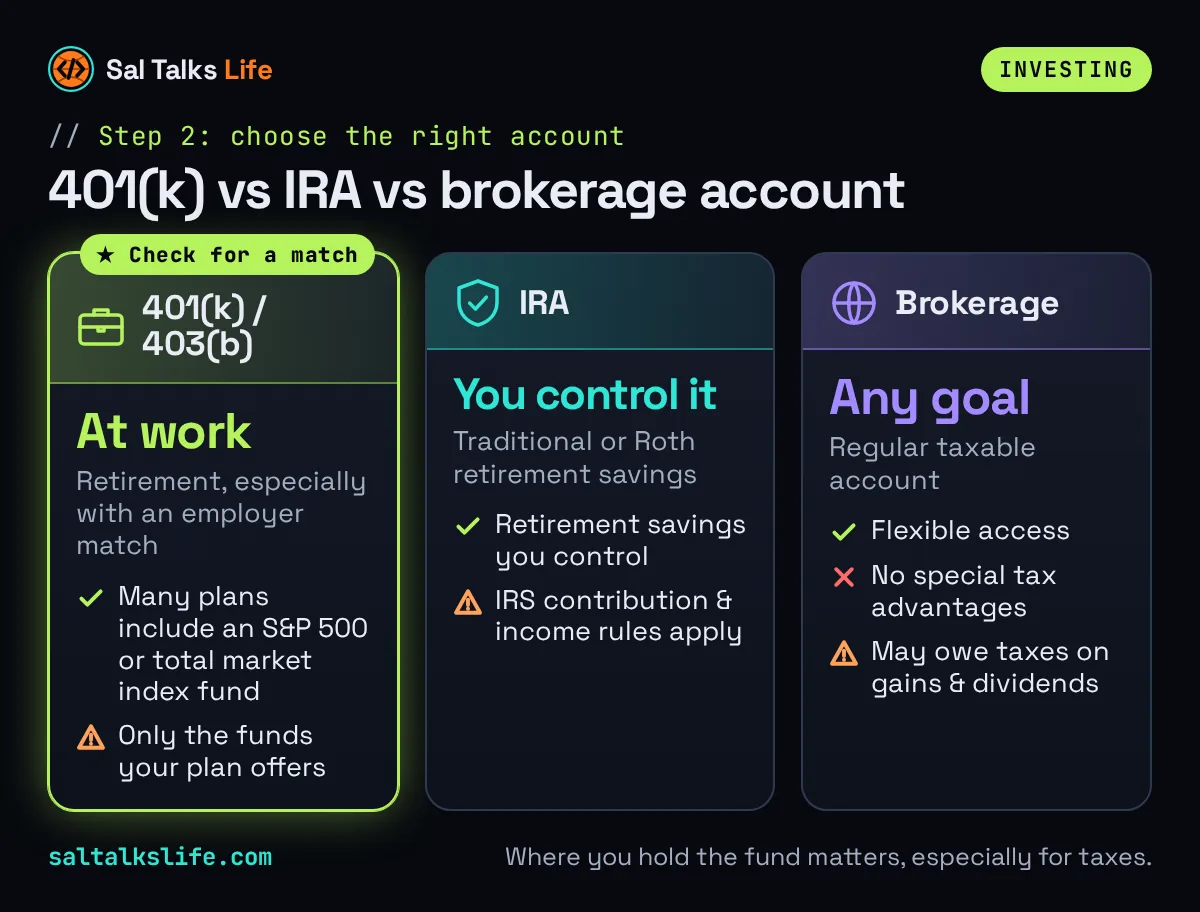
Step 2: Choose the right account
Where you hold the fund matters, especially for taxes.
| Account | Good for | Things to know |
|---|---|---|
| 401(k) or 403(b) at work | Retirement, especially with an employer match | Only the funds your plan offers. Many plans include an S&P 500 or total market index fund. |
| IRA (Traditional or Roth) | Retirement savings you control | IRS contribution and income rules apply. |
| Regular brokerage account | Any goal, with flexible access | No special tax advantages. You may owe taxes on gains and dividends. |
If your job offers a 401(k) match, check whether your plan has an S&P 500 index fund. That might be the easiest place to start.
Step 3: Pick an S&P 500 fund
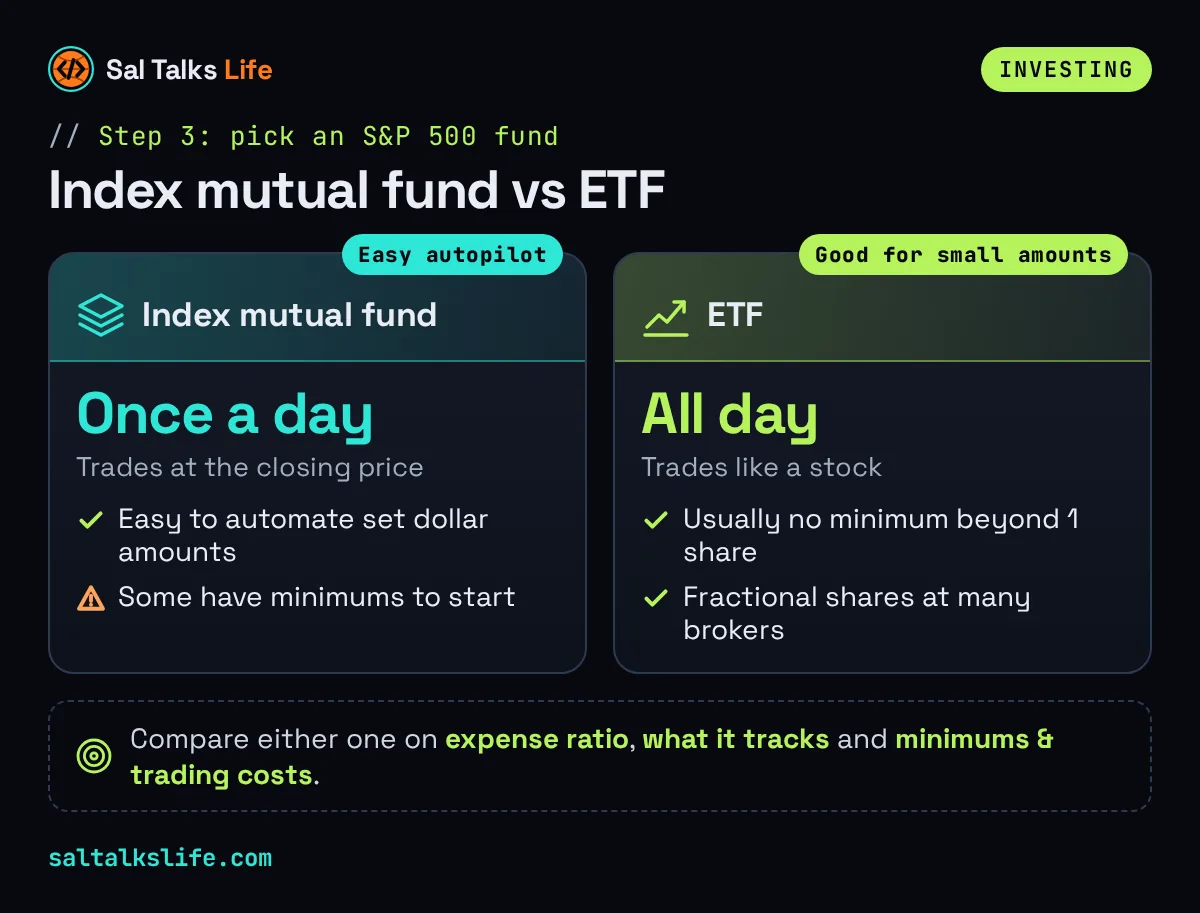
You’ll mainly choose between two types.
Index mutual funds
- Bought and sold once a day at the closing price.
- Some have minimum investments to start.
- Easy to automate with set dollar amounts.
Exchange-traded funds (ETFs)
- Trade throughout the day like a stock.
- Usually no minimum beyond the price of one share, and many brokers now allow fractional shares, so you can invest small amounts.
What to compare
- Expense ratio: the yearly fee as a percentage of your investment. Even small differences add up over many years, so lower is generally better.
- What it tracks: make sure it actually tracks the S&P 500.
- Minimums and trading costs at your broker.
I’m not recommending a specific fund here. Most large brokers offer at least one low-cost S&P 500 option, and they’re often very similar.
If you don’t have a brokerage account yet, online brokers and investing apps such as Robinhood and SoFi Invest let you open an account online. Compare fees, available funds and account types before you pick one.
Step 4: Decide how much to invest
There’s no magic number. Start with an amount that fits your budget, even if it’s small. What matters most is consistency.
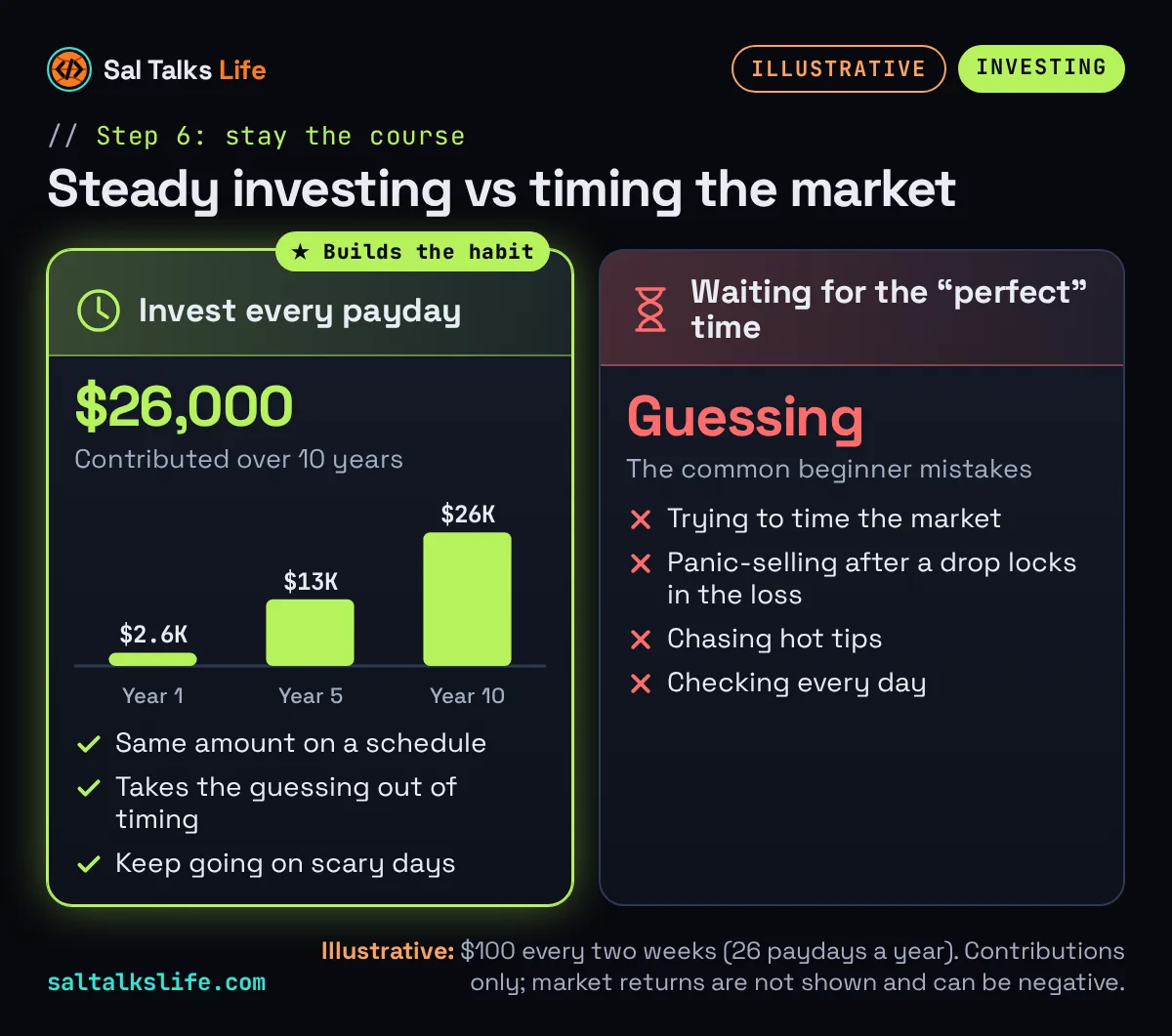
Many beginners use dollar-cost averaging: investing the same amount on a schedule, like every payday, no matter what the market is doing. This builds the habit and takes the guessing out of timing.
Step 5: Buy and automate
- Log in to your account.
- Search for the fund’s ticker symbol.
- Enter the dollar amount or number of shares.
- Review and place the order.
- Set up automatic contributions and dividend reinvestment if you’d like dividends to buy more shares.
That’s it. You’re an S&P 500 investor.
Step 6: Stay the course
This is the hardest part, honestly. The market will have scary days. When it does:
- Don’t panic-sell. Selling after a big drop locks in the loss.
- Keep investing on your schedule if your situation hasn’t changed.
- Check less often. Daily checking can make you nervous for no good reason.
- Rebalance once in a while if you hold other investments too.
I try to approach money the way I approach life: with patience, gratitude and trust that steady faithfulness over time matters more than any single day.
Where an index fund fits (and the 3 ways money gets taxed)
I love how simple an S&P 500 index fund is. But I want you to see it for what it is: one bucket in a bigger plan. Its value is variable, so it goes up and down with the market. And how it’s taxed depends on the account you hold it in.
Here’s the simple way I explain it. Money generally gets taxed one of three ways:
| Bucket | How it works | Examples |
|---|---|---|
| Tax now | You pay taxes on the money going in, and on interest, dividends and gains along the way | Regular brokerage account, savings account |
| Tax later | Contributions usually go in before taxes, and you pay income tax when you take money out in retirement | Traditional 401(k) or 403(b), Traditional IRA |
| Tax-advantaged | You pay taxes on the money going in, and qualified growth and withdrawals can come out tax-free | Roth IRA, Roth 401(k), and properly structured cash-value life insurance like an IUL |
An S&P 500 index fund can live in the first two buckets, or in a Roth account in the third. It’s the same fund, taxed differently depending on where you hold it.
Some people, once they have their emergency fund, a plan for high-interest debt and their full 401(k) match, also look at an indexed universal life (IUL) policy. An IUL is permanent life insurance. Its cash value is credited based on an index like the S&P 500, and it can offer tax-advantaged growth plus a death benefit that protects your family. It’s not the same as owning the index fund, though. IULs have caps that limit your upside in strong years, floors that limit credited losses in down years, and fees and insurance costs that come out every month. They need consistent funding to work well, and caps can change over time.
So I see an IUL as an option worth a free review on top of your match, not instead of it. For some families it fits. For others, simple term coverage plus their retirement accounts is the better plan.
Common beginner mistakes
- Trying to time the market, waiting for the “perfect” moment.
- Ignoring fees. A higher expense ratio quietly eats returns.
- Investing money you’ll need soon. Money for next year’s bills shouldn’t be in stocks.
- Putting everything in one place without thinking about your whole picture, like bonds, international stocks, or which tax bucket your money sits in, as you grow.
- Chasing hot tips instead of sticking to the plan.
FAQ
Can I invest in the S&P 500 with little money?
Yes. Many brokers offer fractional shares, so you can invest small amounts in an S&P 500 ETF. Some mutual funds have minimums, so check before you choose. Starting small and staying consistent is a great way to begin.
Is investing in the S&P 500 safe?
It’s diversified across many large companies, but it’s not risk-free. The index can lose value, sometimes for long stretches. It tends to fit long-term goals better than short-term ones. Only invest money you won’t need for several years.
What’s the difference between an S&P 500 index fund and an ETF?
Both can track the same index. Index mutual funds trade once a day at the closing price and may have minimums. ETFs trade throughout the day like stocks and can often be bought in fractional shares.
Should I invest in the S&P 500 in a Roth IRA?
Many people do, because qualified withdrawals from a Roth IRA are tax-free in retirement. Whether it fits you depends on your income, tax situation and goals. A tax professional can help you decide.
Should I use an IUL instead of my 401(k)?
For most people, no. A common order is an emergency fund first, then high-interest debt, then the full 401(k) employer match. An IUL can be worth a look on top of that if you also want permanent life insurance and tax-advantaged growth, as long as you understand its caps, floors and fees and can fund it consistently. I’ll compare the two side by side in an upcoming post.
How often should I invest?
Many beginners invest on a set schedule, like every payday or once a month. Automating it makes it easier to stay consistent without trying to guess where the market is headed.
Keep learning
The S&P 500 is a solid starting point for a lot of beginners because it keeps things simple. If you’d like to understand how markets work on a deeper level, the Financial Markets course from Yale on Coursera is one option to explore. And if you’re ready for more advanced topics later, my post What Is Options Trading? explains the basics.
Want more plain-English investing posts? Join the free Sal Talks Life newsletter, browse the Investing 101 posts, and find the videos on YouTube.
Not sure which bucket fits you?
If you’re wondering how an index fund, your 401(k), a Roth IRA and maybe an IUL fit together for your family, that’s exactly what my free financial review is for. As an independent financial professional, I can look at your options side by side and explain them in plain English, with no pressure. Book your free financial review.
Some links in this post are affiliate links, which means I may earn a small commission at no extra cost to you. I only share resources I think can help.
Educational content only, not financial, investment or tax advice. Investing involves risk, including the possible loss of money. I’m a licensed life insurance professional (license LA-1933647); IUL features, caps, floors, fees and availability vary by company and state.
Want the video version? Find more on Sal Talks Life.
Comments & reactions
Comments are coming soon. Until then, ask your question under the matching video on YouTube (opens in a new tab) or TikTok (opens in a new tab), or send me a message.