What Is Options Trading? Explained for Beginners
What is options trading? A beginner's guide to how options work: contracts, premiums, strike prices, expiration, the real risks, and how to get started safely.
What is options trading? Here’s the plain-English version. Options trading is buying and selling contracts that give you the right, but not the obligation, to buy or sell a stock at a set price before a set date. You aren’t trading the stock itself. You’re trading a contract about the stock.
People use options for three main reasons: to try to profit from a price move, to protect shares they already own, or to bring in some extra income. Options can be genuinely useful. They can also hurt you fast if you jump in without understanding them.
I’m Sal. I built OptionScout, a small tool for researching options, and I wrote a beginner ebook on one strategy I use. Think of this as “options trading for dummies,” minus the jargon and minus anybody making you feel like one.
The quick version
- An option is a contract tied to an underlying stock or ETF.
- A call gives you the right to buy. A put gives you the right to sell.
- You pay a premium to buy an option.
- Every option has a strike price and an expiration date.
- One standard contract usually covers 100 shares.
- Buyers can lose the whole premium. Sellers can lose a lot more.
What are options in trading?
The easiest way I’ve found to explain it is a deposit that holds a price.
Say you want to buy a house. The owner agrees to hold the price at $300,000 for three months if you pay a $3,000 fee. If prices in the neighborhood jump, you’re happy you locked it in. If prices drop, or you change your mind, you walk away and all you’ve lost is the fee.
Options work a lot like that. You pay a fee (the premium) for the right to buy or sell a stock at a set price (the strike price) until a set date (the expiration date).
The key terms, explained simply
| Term | What it means |
|---|---|
| Underlying | The stock or ETF the option is based on |
| Call option | The right to buy at the strike price |
| Put option | The right to sell at the strike price |
| Strike price | The locked-in price in the contract |
| Expiration date | The last day the option is valid |
| Premium | The price you pay for the option |
| Contract | Usually covers 100 shares of the underlying |
| In the money | The option has value if exercised right now |
| Out of the money | The option has no exercise value right now |
One thing that trips up almost every beginner: option prices are usually shown per share. So a $2.00 premium on one standard contract really costs about $200 (2 x 100 shares), plus any fees.
Calls and puts in one minute
- Buy a call if you think a stock will go up.
- Buy a put if you think a stock will go down, or to protect shares you own.
That’s the short version. I’m working on a separate post on call vs put options with full worked examples.
Why do people trade options?
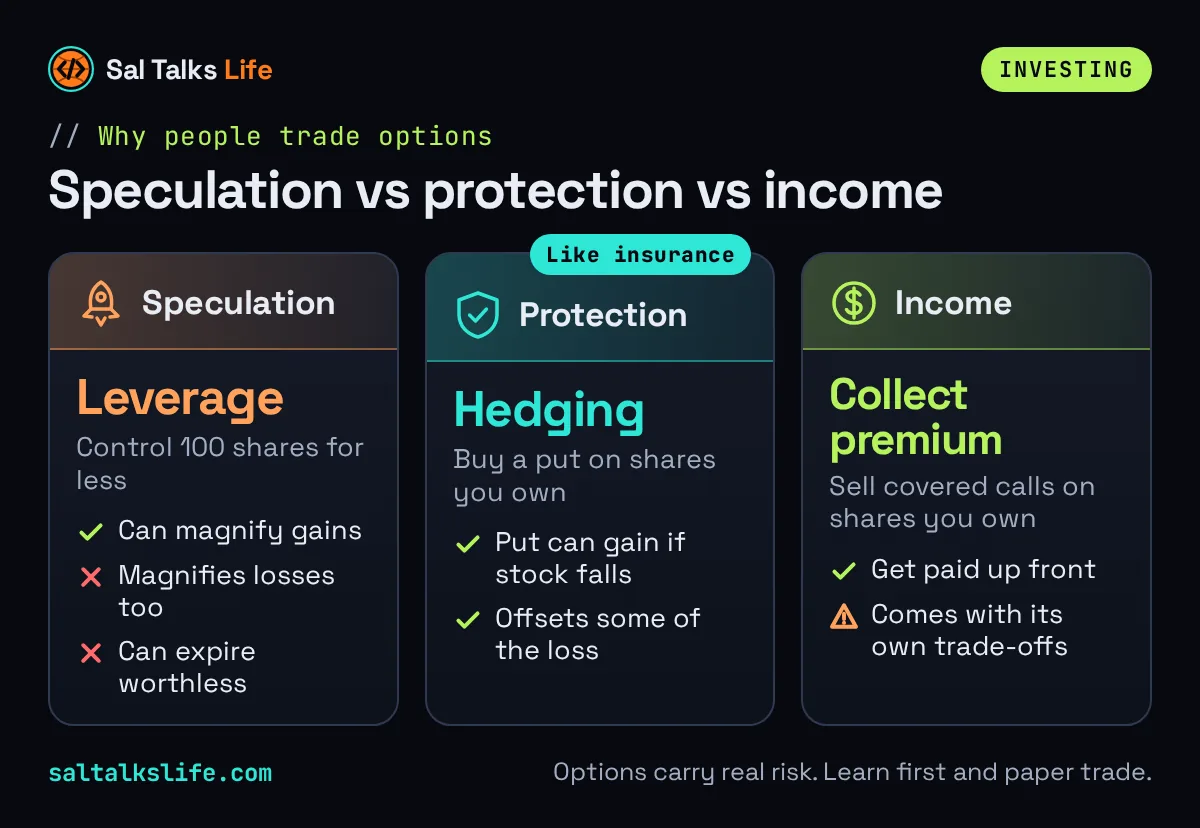
1. Speculation
Options can let you control 100 shares for a lot less money than buying them outright. That leverage can make your gains bigger. It makes your losses bigger too.
2. Protection (hedging)
If you own shares and you’re nervous about a drop, you can buy a put, kind of like insurance. If the stock falls, the put can gain value and soften some of the loss. (Yes, the insurance guy likes this one.)
3. Income
Some investors sell options to collect the premium, like selling covered calls on shares they already own. It has its own trade-offs, which I’ll get into in another post.
What affects an option’s price?
You don’t need to master the math. It does help to know what pushes an option’s price around:
- The stock price compared to the strike price.
- Time until expiration. More time usually means a higher premium. As expiration gets closer, options tend to lose value. This is called time decay.
- Volatility. When a stock is expected to move a lot, options usually cost more.
- Interest rates and dividends, which play a smaller role.
The real risks of options trading
I’m going to be straight with you here, because this is the part where beginners get hurt.
- Options can expire worthless. If you buy an option and the stock doesn’t move the way you need in time, you can lose your entire premium.
- Time works against buyers. You can be right about the direction and still lose money if the move comes too late.
- Selling options can have big risk. Selling uncovered (naked) calls has theoretically unlimited risk.
- Leverage cuts both ways. Small stock moves can mean big percentage swings in an option.
- It’s easy to overtrade. Quick wins feel great, and that’s exactly when people start taking on too much.
FINRA has a helpful beginner overview of how options work and their risks. Your broker will also hand you an options disclosure document before you can trade. Please actually read it. I know it’s long.
How to get started with options, safely
- Learn the basics first. Calls, puts, premiums, strikes, expiration and time decay.
- Make sure your foundation is solid. Emergency fund, no high-interest debt, and long-term investing in place. My post on how to invest in the S&P 500 covers that foundation.
- Open a brokerage account and apply for options approval. Brokers have different approval levels based on your experience and finances.
- Paper trade. Many brokers offer practice accounts so you can try trades without real money. For example, moomoo has a free paper trading feature that includes options.
- Start small. Use money you can afford to lose completely.
- Stick to simpler, defined-risk strategies while you learn. A post on beginner-friendly options strategies is on my list.
- Have a plan for every trade: why you’re entering, when you’ll take profit, and when you’ll exit if you’re wrong.
FAQ
Is options trading good for beginners?
It can be, if you learn the basics first, start small and use defined-risk strategies. It’s not a good fit if you’re looking for quick money or using funds you can’t afford to lose. Many beginners build a long-term investing base first.
How much money do I need to start trading options?
There’s no single minimum. Some options cost a few dollars per share in premium, which is a few hundred dollars per contract, and others cost much more. Brokers also have their own requirements for options approval. Focus on risking only what you can afford to lose.
Can you lose more than you invest with options?
If you buy calls or puts, the most you can lose is the premium you paid. If you sell options, losses can be larger than the premium you collected, and selling uncovered calls has theoretically unlimited risk.
What’s the difference between options and stocks?
A stock is a share of ownership in a company. An option is a contract that gives you the right to buy or sell a stock at a set price before a set date. Options expire, while stocks don’t.
Do I have to exercise an option?
No. Most traders close options by selling them before expiration instead of exercising. Check how your broker handles options that are in the money at expiration so nothing surprises you.
Keep learning
Options are a tool, nothing more. Used carefully, they can help you protect and grow what you’ve built. Used carelessly, they can do real damage in a hurry. Take your time. Be patient with yourself.
If you want to explore a strategy that uses long-dated calls in place of owning 100 shares, my ebook, The LEAPS + Short Call Playbook, walks through how I pair deep in-the-money LEAPS with short calls (often called the Poor Man’s Covered Call) step by step. And if you’d like a university-style foundation in finance, edX has free and paid finance courses you can take at your own pace.
Want more plain-English investing posts? Join the free Sal Talks Life newsletter, browse the Investing & Options topic, and find the videos on YouTube.
Keep reading
- How to Invest in the S&P 500: A Beginner’s Step-by-Step Guide
- The 50/30/20 Rule: A Simple Budget That Helps You Save Money
- How to Build Credit From Scratch: A Simple Beginner’s Guide
Some links in this post are affiliate links, which means I may earn a small commission at no extra cost to you. I only share resources I think can help.
Educational content only, not financial advice.
Want the video version? Find more on Sal Talks Life.
Comments & reactions
Comments are coming soon. Until then, ask your question under the matching video on YouTube (opens in a new tab) or TikTok (opens in a new tab), or send me a message.