Blog / Life Insurance & Protection
Living Benefits Life Insurance, Explained in Plain English
Living benefits life insurance explained: how accelerated death benefit riders work, chronic, critical and terminal illness benefits, costs, and what to ask.

Most people I talk to think life insurance only pays out after you die. That’s the part everybody knows. What a lot of folks have never heard of is living benefits life insurance: features, usually called riders, that can let you use part of your policy’s death benefit while you’re still alive if you’re diagnosed with a qualifying terminal, chronic or critical illness.
That money can go toward medical bills, the mortgage, lost income, or just giving your family some room to breathe during a really hard season.
I’m Sal, a licensed life insurance Financial Professional with Global Financial Impact (license LA-1933647). When I sit down with a family, living benefits are one of the first things I bring up, because almost nobody knows to ask about them.
The quick version
- Living benefits let you use part of your death benefit early for a qualifying illness or injury.
- The most common types cover terminal, chronic and critical illness.
- Whatever you use early is usually subtracted from what your beneficiaries get later.
- Many policies include some living benefits at no added premium. Others charge for certain riders.
- The details vary a lot by company, policy and state, so read the rider language.
What are living benefits in life insurance?
Most living benefits sit on top of something called an accelerated death benefit rider. “Accelerated” just means you get some of the death benefit sooner. Instead of the whole amount going to your beneficiaries after you pass, you can tap a portion while you’re living, as long as you meet the rider’s conditions.
The policy is still there to protect your family. Living benefits just give you a way to use some of that protection when you need it most, instead of only at the very end.
The main types of living benefits
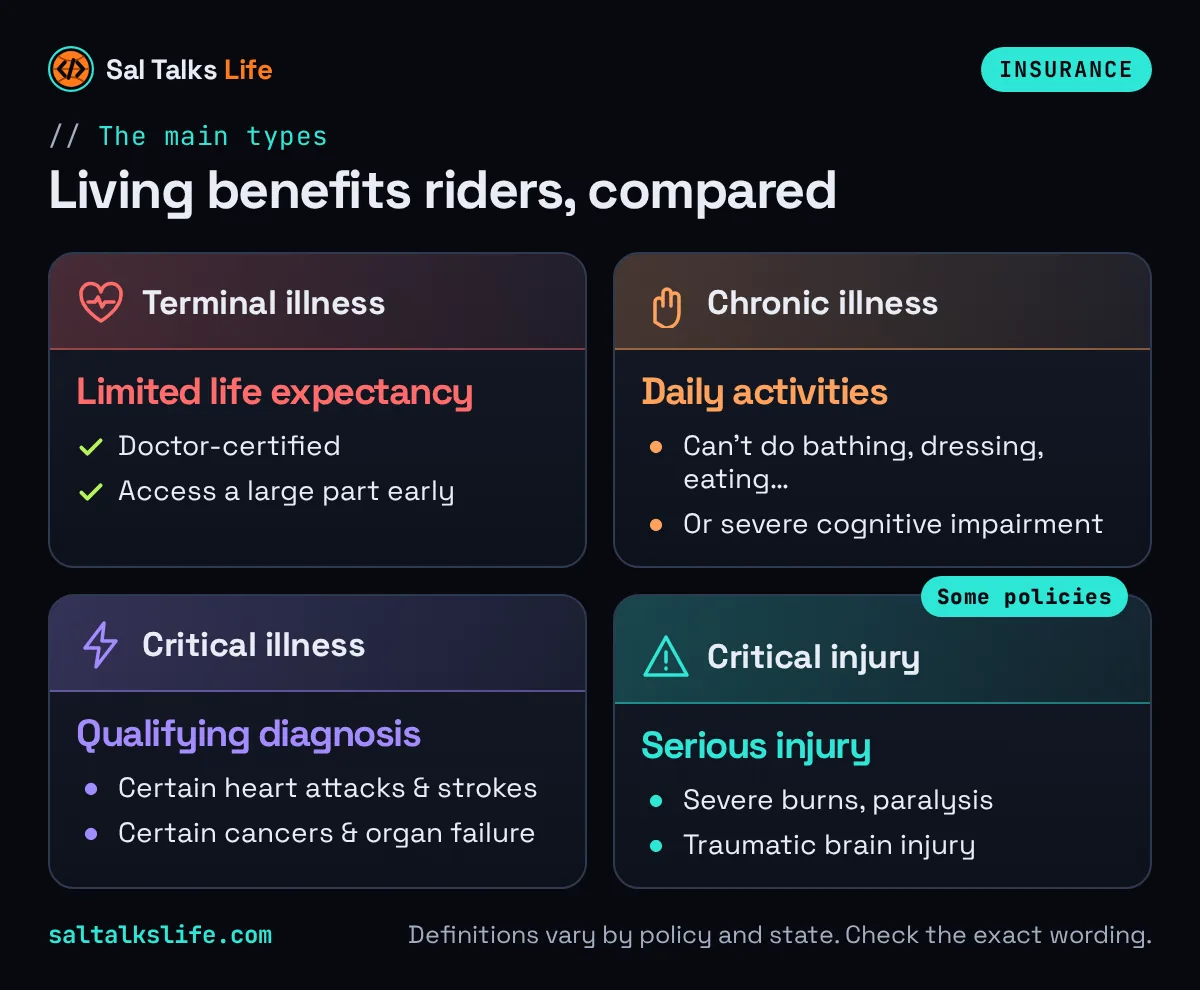
Terminal illness
If a doctor certifies that you have a terminal illness with a limited life expectancy (the exact time frame is spelled out in the policy), you may be able to access a big part of your death benefit early. For a lot of families, that means more time together and less time worrying about bills.
Chronic illness
This one may kick in if you can’t do a certain number of activities of daily living anymore: bathing, dressing, eating, using the toilet, getting in and out of a bed or chair, or continence. A severe cognitive impairment can also qualify. Policies define all of this carefully, so check the exact wording.
Critical illness
A critical illness benefit may apply after a qualifying diagnosis or event, like certain heart attacks, strokes, cancers or organ failures. Which conditions count, and how severe they have to be, depends on the policy.
Critical injury (on some policies)
Some policies also cover serious injuries, such as certain severe burns, paralysis or traumatic brain injuries.
How living benefits work, step by step
- Something qualifying happens. A diagnosis or condition that meets the rider’s definition.
- You file a claim with the insurance company, usually with medical records.
- The company reviews it against the rider’s terms.
- You get paid, often as a lump sum, though some riders pay out differently.
- Your remaining death benefit goes down. What you used, and sometimes a discount or fee, comes out of what your beneficiaries eventually receive.
How much you can get, and how it’s calculated, isn’t the same everywhere. Some riders pay a set percentage of the death benefit. Others work out a discounted amount based on things like your age and condition. That’s exactly why I keep telling people to read the rider.
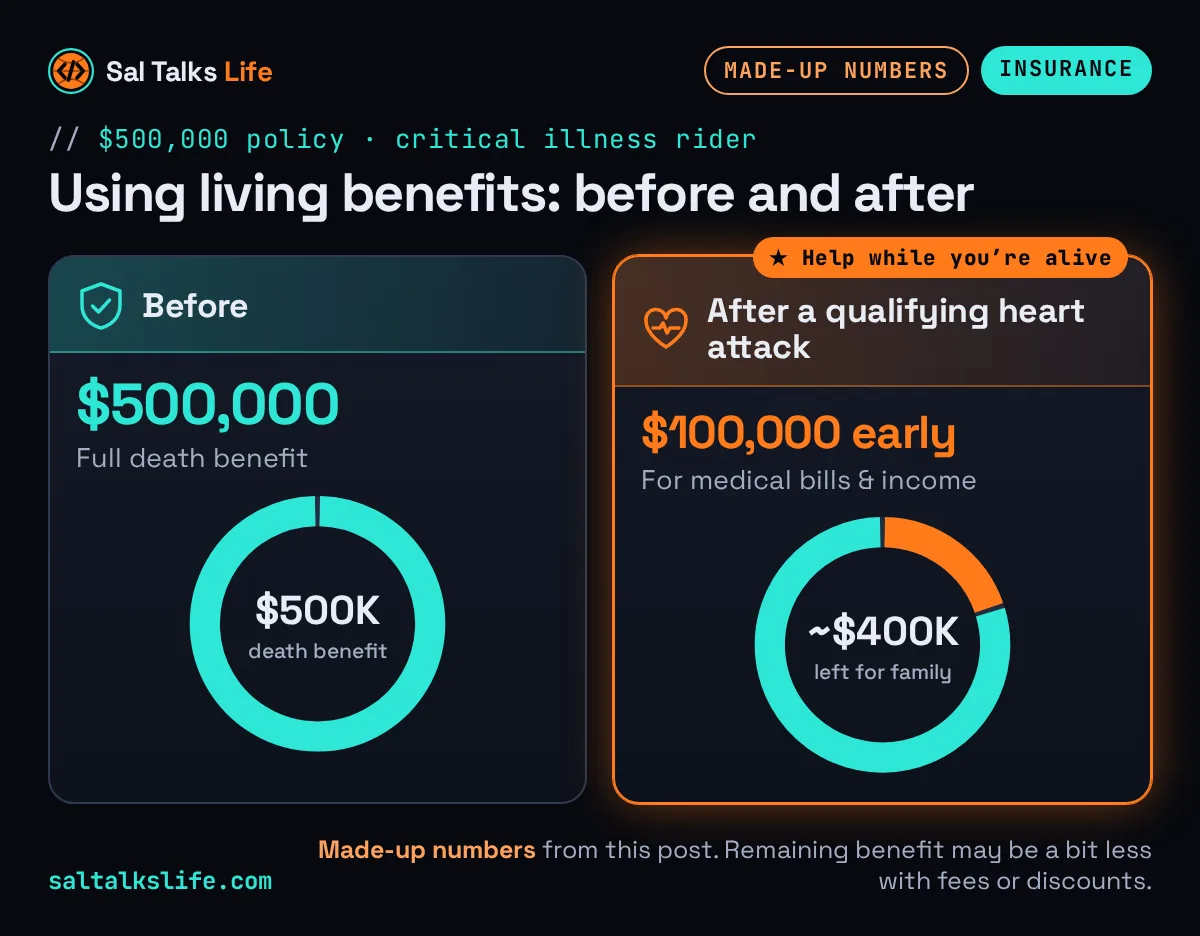
A simple example with made-up numbers
These numbers are only for illustration. They don’t come from any real policy.
Say you’ve got a $500,000 policy with a critical illness rider. You have a qualifying heart attack, and you’re approved to access $100,000 early.
- You use that $100,000 for medical bills and to cover your income while you recover.
- Your remaining death benefit drops to around $400,000, maybe a little less if the rider has a discount or admin fee.
Your family’s still protected. And you got help at the moment you actually needed it.
Which policies offer living benefits?
You can find living benefits on both term and permanent policies, including whole life and indexed universal life (IUL). Not every policy has them, though, and no two companies write them exactly the same way.
This is personal for me. Until July 2026, I was a captive agent with Globe Life, which meant I could only offer one company’s products. I moved to Global Financial Impact so I could offer more products. Now, when a family asks me about living benefits, I can line up riders from different companies and show them how the definitions and payouts actually compare, instead of handing them a single option.
If you’re still deciding what kind of policy you want, start with Term vs Whole Life Insurance. I’m also working on a plain-English post about IULs.
Living benefits pros
- Help while you’re alive. Money during a serious illness, not just after.
- You decide how to use it, in many cases.
- Often built in. Plenty of policies include certain living benefits riders without a separate premium. You usually only “pay” if you use them, through the smaller death benefit.
- Peace of mind. One policy covers more of life’s what-ifs.
Living benefits cons and things to watch
- Using it shrinks the death benefit. Less is left for your beneficiaries.
- The definitions are strict. Your condition has to match the policy’s wording.
- Payouts can be discounted. Some riders pay less than dollar-for-dollar.
- It doesn’t replace health insurance, or long-term care insurance in every situation.
- Taxes and benefits can be affected. Accelerated benefits are often received tax-free, but it depends on your situation, and a payout could affect eligibility for some need-based programs. Talk to a tax professional.
Questions to ask before you buy
- Which living benefits are included, and which cost extra?
- Exactly which conditions qualify, and how are they defined?
- How much of the death benefit can I access, and how is the payout figured?
- Are there fees or discounts when I use it?
- Is there a waiting period?
- What happens to my premiums and remaining coverage after I use it?
FAQ
What are living benefits on a life insurance policy?
Living benefits are riders that let you access part of your death benefit early if you have a qualifying terminal, chronic or critical illness or, on some policies, a critical injury. The amount you use is generally subtracted from what your beneficiaries receive later.
Do living benefits cost extra?
It depends on the policy. Many policies include some accelerated death benefit riders without an added premium, while other riders have a cost. Ask which ones are included and read the rider details before you buy.
Are living benefits taxable?
Accelerated death benefits are often received income-tax-free when you qualify, but the rules depend on the type of benefit and your situation. Check with a tax professional before you file a claim.
Can I add living benefits to a policy I already have?
Sometimes, but often riders must be added when the policy is issued. Contact your insurance company or agent to see what’s available on your current policy.
Is a living benefits rider the same as long-term care insurance?
Not exactly. A chronic illness rider can help with some similar needs, but long-term care insurance is a separate product with its own rules and benefits. Compare the two if long-term care is a big concern for your family.
Want to know if your policy has living benefits?
A lot of the families I talk with already have a policy and honestly don’t know what’s in it. Others have never heard the words “living benefits” until we talk. Either way, I’d be honored to help you sort it out. My mission, by the grace of God, is to help as many families as I can get protected, for the hard what-ifs while they’re living and for the day they’re gone.
Book your free financial review and we’ll go over your current coverage or your options together, in plain English, with no pressure. You can also learn more on my Financial Services page.
For more plain-English money posts, join the free Sal Talks Life newsletter or browse everything in the Life Insurance & Protection topic.
Keep reading
- How Much Life Insurance Do I Need? A Simple Way to Figure It Out
- Term vs Whole Life Insurance: Which One Fits Your Family?
- The 50/30/20 Rule: A Simple Budget That Helps You Save Money
Educational content only, not financial advice.
More on Life Insurance & Protection →
Want the video version? Find more on Sal Talks Life.
Comments & reactions
Comments are coming soon. Until then, ask your question under the matching video on YouTube (opens in a new tab) or TikTok (opens in a new tab), or send me a message.